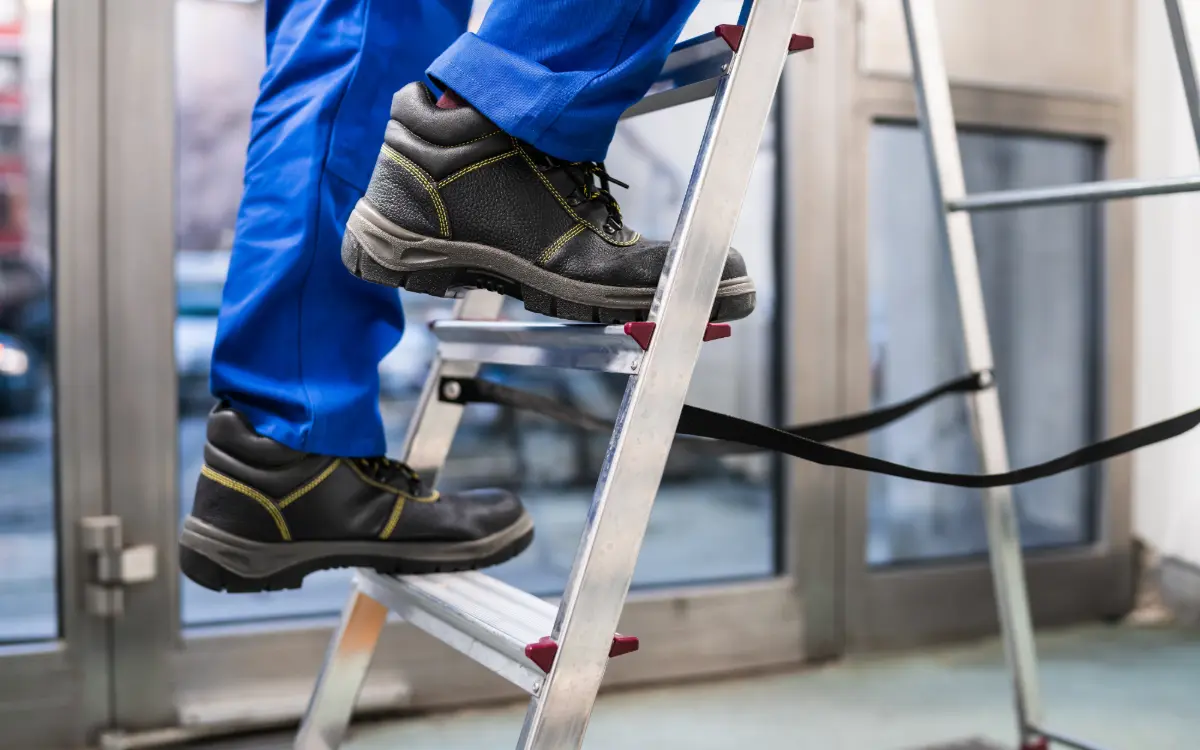
Working at height is one of the leading causes of serious and fatal accidents in the construction industry. Any task carried out more than two metres above ground level demands the rigorous implementation of preventive measures to eliminate or mitigate the risk of a fall from height.
In the day-to-day running of a site, the pressure to make progress on roofing, structural or façade work often leads to the incorrect use of harnesses, a failure to clip onto lifelines or carelessness when installing edge protection. A fall from height leaves no margin for error and gives rise to immediate criminal liability for the technical management.
To control working at height regulations and safety measures effectively, the contractor must plan the protection systems, train personnel in fall-arrest techniques and check the condition of the equipment.
In this article we examine the current legislation, the priority of collective protection over personal protection, and the digital management of these inspections. To coordinate this work within the wider preventive framework, see our general guide to site safety.

Regulatory framework for working at height in construction
Royal Decree 2177/2004 sets out the minimum health and safety provisions for the use by workers of work equipment involving temporary work at height. The regulation establishes the overriding obligation to install collective protection before resorting to personal equipment.
Likewise, the Occupational Risk Prevention Act requires all operatives exposed to this risk to receive specific theoretical and practical training in the use of fall-arrest and rescue systems.
Key legal requirements
- Statutory height threshold: Any work carried out at a height difference of more than two metres relative to the ground is considered working at height.
- Priority of collective protection: Safety nets, rigid guardrails or walkways must preferably be installed before equipping the operative individually.
- Planning and supervision: A requirement to ensure the presence of preventive resources on site while high-risk tasks are being carried out.
Collective and personal protection systems
Preventing falls requires an appropriate combination of physical containment barriers and certified personal restraint equipment.
The use of any means of protection requires prior verification of its certification and condition before starting the work.
Collective protection measures
- Edge guardrails: Rigid structures made up of a top handrail (at least 90 cm), an intermediate rail and a toe board or kickboard to prevent objects from falling.
- Safety nets: Fan-type or bracket-type catch systems designed to arrest the fall of people or materials from upper floor slabs.
- Opening covers: The covering and secure fixing of all ventilation openings, light wells or downpipe openings in the floor slabs.
Personal fall-arrest equipment (PPE)
- Fall-arrest harness (EN 361): A body-holding device intended to arrest falls while ensuring the distribution of impact forces.
- Horizontal and vertical lifelines: Certified flexible or rigid anchor systems (EN 795) to which the energy absorber is connected.
- Retractable fall-arrest devices: Mechanical absorbers that automatically lock the webbing or cable in the event of a sudden acceleration.
Equipment checks and rescue plan for work at height
The effectiveness of fall-arrest equipment depends directly on its correct maintenance and on the speed of response in the event of an emergency.
So-called suspension trauma, or harness syndrome, requires the rapid rescue of a suspended operative to avoid serious physiological consequences.
Control and rescue requirements
- Mandatory annual inspection: All fall-arrest equipment (Category III of the mandatory PPE in construction) must be inspected periodically by qualified personnel.
- Rescue procedure in the emergency plan: The site emergency and evacuation plan must include the means to lower the worker in less than 15 minutes.
Digital control and inspection of work at height
Supervising the correct installation of edge protection and the clipping-on of lifelines requires continuous monitoring at the work face.
Using site safety management software, safety officers can audit safety conditions on roofs and scaffolds with digital checklists. This keeps the mandatory documentation on a construction site up to date.
Step 1: Audit the condition of the anchor points and lifelines. Verify the manufacturer's certification and the current inspection tag. Step 2: Check the installation of collective protection. Inspect that the edge guardrails have no gaps or uncovered sections. Step 3: Complete the checklist from the mobile app. Fill in the site safety checklist, photographing any defect in the harness or connectors. Step 4: Notify the contractor of the corrective order. Send an automatic notice with a deadline to remedy the detected faults before authorising the work.
How Trowel helps
| Problems | How Trowel solves it |
|---|---|
| Risk of using expired or uninspected harnesses or lifelines | Digital register of Category III equipment with automatic expiry and inspection alerts |
| Failure by operatives to use a harness on roofs or floor slabs | Immediate notification of non-conformities with photos taken at the work face from the app |
| Difficulty certifying the daily inspections of edge protection | Mobile checklists with digital signature and GPS coordinates in the Health & Safety module |
You can see the technical detail of each module in Trowel Academy.
Frequently asked questions
At what height does using a safety harness become mandatory?
It is mandatory to use a fall-arrest harness clipped to a secure anchor point whenever work is carried out more than two metres above ground level without effective collective protection.
Can a worker carry out work at height alone?
No, high-risk work at height must be carried out accompanied and under the supervision of a preventive resource, so that action can be taken immediately in the event of a fall.
How often must a safety harness be inspected?
It must be inspected visually by the operative before each use and undergo a formal technical inspection every 12 months, or after being subjected to the load of a fall.
Conclusion
Rigorous compliance with the rules on working at height regulations and safety measures is essential to eradicate falls from height in the construction sector. Prioritising collective protection and ensuring that personal equipment is inspected saves lives every day.
Digitising technical inspection processes at the work face guarantees the traceability of controls and speeds up the resolution of dangerous situations. If you want to optimise safety supervision on your sites, request a free Trowel demo.
You may also be interested in
- Mandatory PPE in construction →
- Preventive resources on site →
- Site safety checklist →
- Site emergency and evacuation plan →
Recommended reading