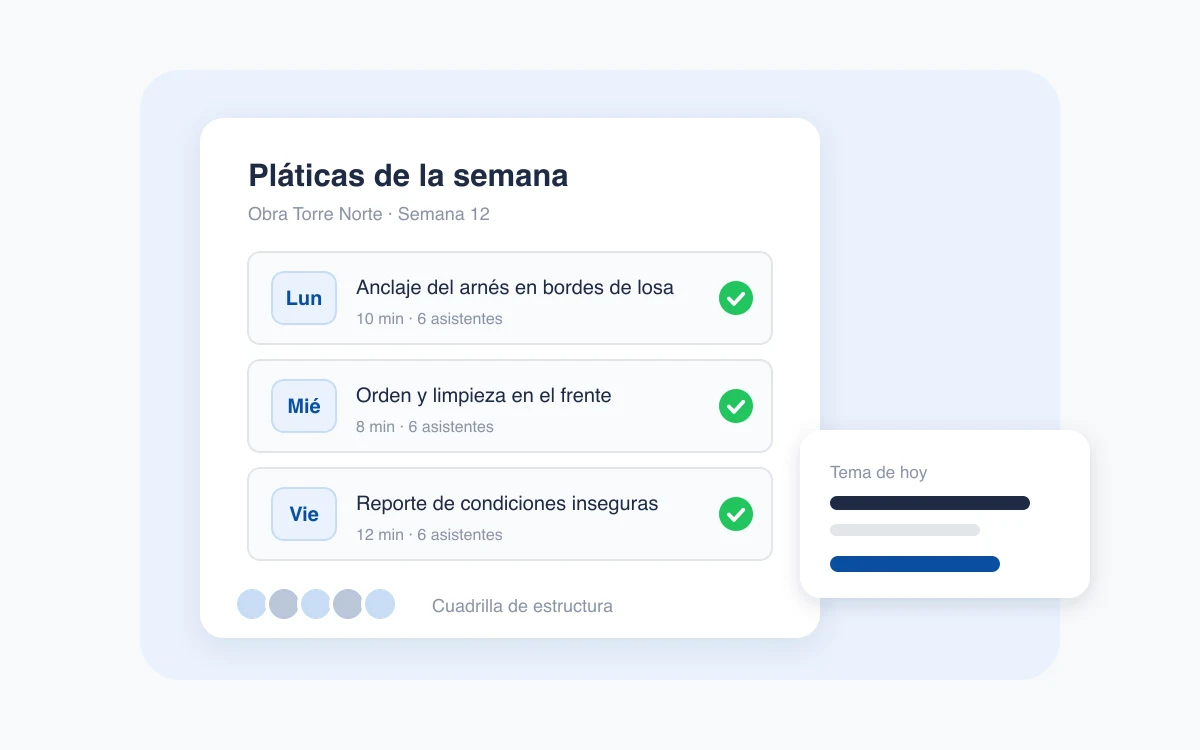
An annual training session lasting several hours rarely changes day-to-day behavior on site. A short session at the start of the week, focused on a specific risk relevant to the current stage of the project, usually achieves more within construction safety: it keeps the risk present in the team's mind right before they are exposed to it.
This guide explains what toolbox talks are, how to structure them so they actually stick, and offers a bank of topics organized by type of risk so you don't have to improvise every week.
What is a toolbox talk?
On many sites in México they are known as five-minute talks or start-of-shift talks, because they are given at the beginning of the workday or the week, before work starts. A toolbox talk is a short session, between 5 and 15 minutes, addressing a specific risk relevant to that week's activities or that work face. Unlike formal training, which tends to be longer and to cover a complete subject, the toolbox talk works as an active reminder, applied right before the team is exposed to the risk being discussed.
It does not replace the training required by regulation, such as the training NOM-017-STPS requires for the use of PPE, but it is the complement that keeps that training present day to day, instead of leaving it as a distant memory from the initial induction.
How to structure an effective toolbox talk
Choose a topic relevant to that week's activity, not a generic one. If the site is in the structural phase with work at height under way, the talk should be about that, not about a risk that is not present at that point in the project.
Keep it short. Between 5 and 15 minutes is enough. A talk that drags on loses the team's attention and becomes wasted time rather than a preventive tool.
Use a concrete example, ideally from the site itself. A real incident or near miss from the previous week, without naming anyone at fault, is far more effective than a theoretical explanation of the risk.
Leave room for questions and comments from the team. Those doing the work in the field often spot risks the office never sees; the talk is also an opportunity to hear that information.
Document the talk with date, topic and attendees. That record forms part of the evidence of ongoing training that may be requested during an inspection.
A format for recording a toolbox talk
A simple record, on paper or digital, is enough for each talk to stand as evidence. These are the minimum recommended fields:
| Field | What to note |
|---|---|
| Site and work face | Name of the site and the area or crew it is aimed at |
| Date, time and duration | When it was given and how long it lasted (between 5 and 15 minutes) |
| Topic | The risk covered, for example "harness anchor points at slab edges" |
| Related activity | The task of the week that prompted the topic |
| Who delivered it | Name and job title |
| Key points | The two or three ideas the team must remember |
| Risks reported by the team | What the workers flagged during the talk |
| Agreed actions | What is going to be corrected, who is responsible and by when |
| Attendees | Name and signature of each participant |
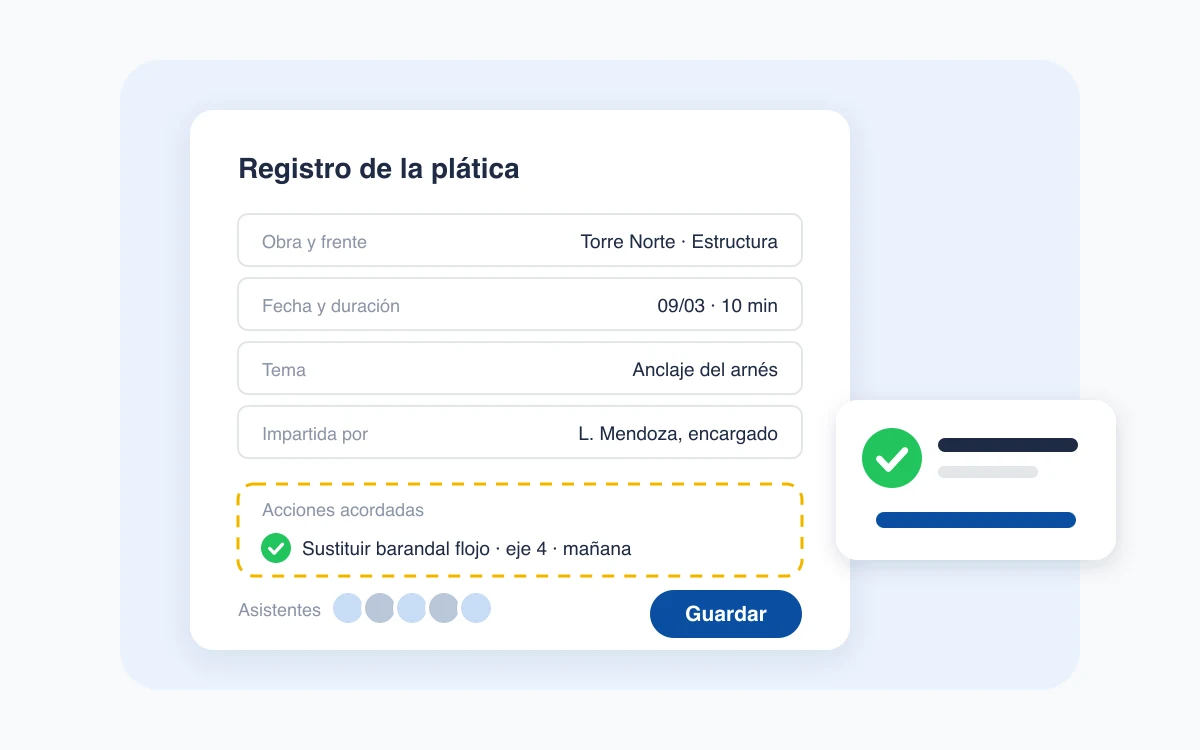
The agreed actions column is what turns the talk into real prevention: if a worker reports a loose guardrail, the record leaves proof of who fixes it and when.
A bank of topics for toolbox talks on site
On unsafe acts and conditions:
- How to report an unsafe condition without waiting for it to turn into an accident
- Why "it will only take a moment" is the phrase behind most avoidable accidents
- The difference between real risk and risk normalized by habit
On work at height:
- How to check the anchor point before connecting the lifeline
- What to do if a guardrail or collective protection is not installed before starting
- Why a harness is useless if the anchor point will not hold
On Personal Protective Equipment:
- How to inspect PPE before every shift, not just when you receive it
- When a hard hat, harness or glove must be taken out of service even if it looks in good condition
- The right PPE for the day's activity, not whichever is closest to hand
On confined spaces:
- Why you must never go in to rescue someone without first activating the emergency plan
- What it means for a space to be classified as Type II
- The importance of measuring gases before every entry, not just the first one
On machinery and tools:
- Safe circulation zones around cranes and moving machinery
- Why a safety guard must never be removed to work "faster"
- Signals and communication with the operator before approaching equipment in operation
Common mistakes when running toolbox talks
Repeating the same topic without adapting it to the phase of the project. A talk on work at height loses its point if that week the active work face is excavation; the topic should follow the real risk of the moment, not a fixed calendar disconnected from the site.
Not documenting who attended or what was discussed. Without that record, the talk does not count as evidence of ongoing training during an inspection, even if it was held week after week.
Turning it into a monologue with no room for the team. A talk where only the foreman speaks loses the chance for the crew to report risks they see in the field and the office does not.
Frequently asked questions
How often should toolbox talks be held on site?
No single frequency is required by regulation, but the most common practice is weekly, at the start of the Monday shift or before beginning a specific high-risk activity. What matters is consistency, not the exact frequency.
Who should deliver toolbox talks?
Usually the site manager, the supervisor of the work face, or the safety officer when the site has one. What matters is that whoever delivers it knows the activity and the specific risks of that week first hand.
Do toolbox talks replace the formal training required by the STPS?
No. Toolbox talks are a continuous reminder and a complement, but they do not replace the documented formal training required by standards such as NOM-017-STPS for PPE or NOM-033-STPS for confined spaces.
Conclusion
Toolbox talks do not replace formal training, but they are what keeps the risk present in the team's mind right before they are exposed to it, week after week. Choosing the right topic for the phase of the project, keeping the talks short and documenting them is what turns them into a real prevention tool rather than one more formality. Book a Trowel demo and digitize the record of talks and training across your sites.