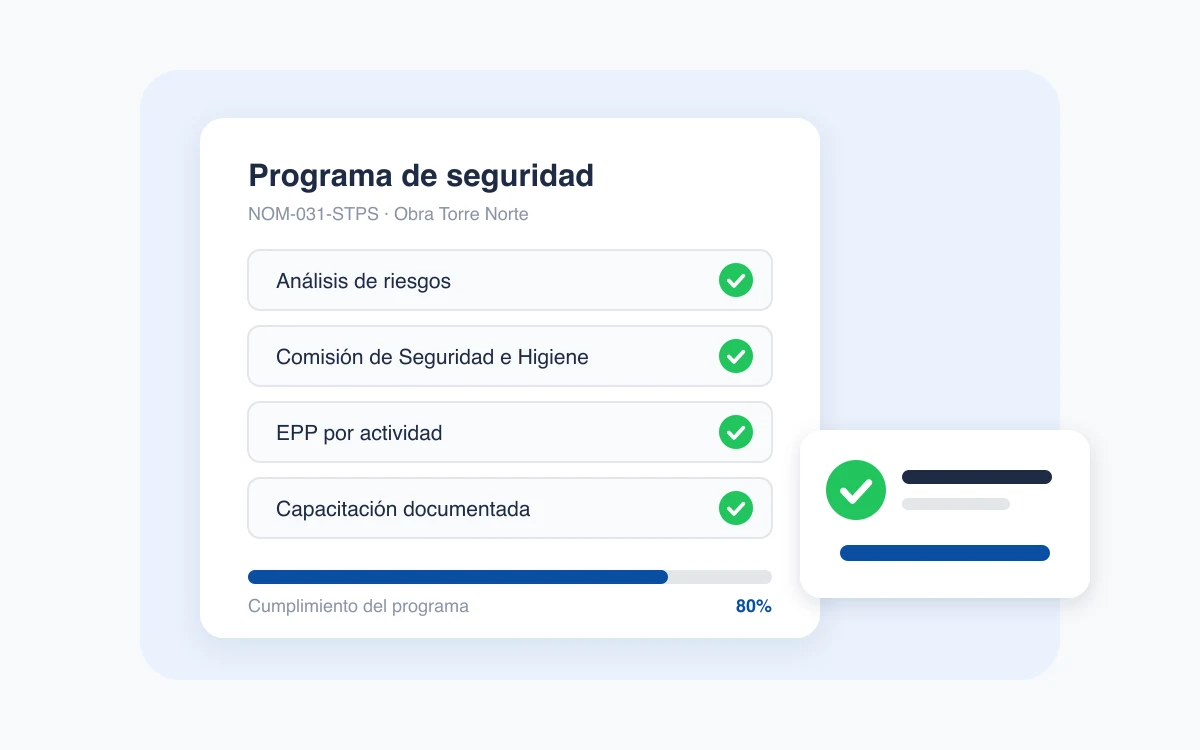
A fall from a scaffold without a harness, an excavation with no battered sides or shoring, a confined space entered without ventilating it first: serious accidents in construction are almost never unpredictable. Almost always they are the same unsafe condition or the same unsafe act repeating itself without anyone correcting it in time. Construction safety is not an administrative formality to be settled before an inspection: it is the system that stops those conditions from turning into an accident.
This guide covers the full picture: what Mexican regulation requires, which risks account for most accidents on site, how to implement a safety program step by step, and what mistakes leave a program existing only on paper. If you are looking for depth on a specific subject, the blog has dedicated guides on unsafe acts and unsafe conditions, Personal Protective Equipment under NOM-017-STPS, confined spaces, work at height, safety and hygiene on site and toolbox talks.
What is construction safety?
Construction safety is the set of conditions, procedures and equipment aimed at preventing accidents and occupational illness on site. It is not limited to wearing a hard hat and a vest: it takes in the risk analysis carried out before each activity starts, site housekeeping and signage, the maintenance of machinery and scaffolding, the training of personnel, and emergency response.
A common mistake is to think that safety depends above all on each worker's individual behavior. In practice, most serious accidents on site have an organizational root cause behind the specific unsafe act or condition: a poorly planned work sequence that forces people to improvise, supervision that is too thin for the number of open work faces, or a procedure that exists on paper but that nobody checked was being applied in the field. That is why an effective safety system does not stop at handing out PPE and hoping everyone uses it: it demands planning, active supervision and documented follow-up.
In México, this area is specifically governed by NOM-031-STPS-2011, Construction: occupational safety and health conditions, published by the Secretaría del Trabajo y Previsión Social (STPS). This standard applies to all construction work carried out on national territory, at any of its stages (only maintenance activities that require neither a building permit nor notice to the authorities fall outside it), and covers, among other points, risk analysis, Personal Protective Equipment, work in excavations, in confined spaces and at height, and the training of personnel before high-risk activities begin.
Unlike an internal policy each company drafts at its own discretion, construction safety in México has a mandatory regulatory floor: it is not an optional good practice but a set of legal obligations with real financial penalties for non-compliance. That distinction matters because it changes the conversation inside the company: the question is not whether to invest in safety, but how to comply efficiently with what the law already requires.
The Health and Safety Commission: a legal obligation, not an option
Article 509 of the Federal Labor Law establishes that every company or workplace must set up a Health and Safety Commission, made up of an equal number of representatives of the workers and of the employer, with the role of investigating the causes of accidents and occupational illness, proposing measures to prevent them and overseeing compliance. The formation, composition and operation of this commission are specifically governed by NOM-019-STPS-2011.
This obligation applies to companies of any size and sector, not only to large contractors. On site, the commission usually meets regularly to review inspection findings, follow up on incidents and near misses, and record the agreed corrective actions in minutes. Not having one, or having it only on paper with no real activity, is one of the most common grounds for penalties when the labor authority inspects a site.
On sites with several work faces or several contractors operating at the same time, the commission also plays a coordinating role that is rarely mentioned: it is the forum where risks arising precisely from the interaction between crews come to light, for example when a subcontractor works at height directly above the area another crew walks through, something neither party separately would have reason to report.
The risks behind most accidents on site
Construction is one of the country's sectors with the highest accident rates. According to IMSS figures compiled by Obras Expansión, 44,474 occupational risks were recorded in the construction industry in 2024, making it the fourth sector with the most cases, and 140 of them ended in death. Between 2020 and 2024 the sector accumulated 783 deaths from occupational risks. The full figures by sector, cause and type of injury are in the IMSS statistical report.
Not every risk on a site carries the same weight. These are the ones that regulation and field experience single out as the most frequent, and the most serious when they occur:
Falls from height. Work on scaffolding, roofs, unprotected slab openings or slab edges without guardrails is among the most frequent causes of serious and fatal accidents in construction. Great height is not needed: NOM-009-STPS-2011 already treats any activity above 1.80 m as work at height, and it is at those moderate heights that the risk is most underestimated and the harness or lifeline most often skipped. We cover the specific measures in work at height: preventing falls on site.
Confined spaces. Cisterns, deep trenches, pits and tanks present the risk of hazardous atmospheres (lack of oxygen, toxic gases) and of entrapment. NOM-031-STPS requires a specific procedure before any worker enters one of these spaces, including checking the atmosphere and appointing an attendant outside. We develop this in confined spaces: risk prevention on site.
Unsafe acts and conditions. These are not just two theoretical categories: they are the tool that makes it possible to identify, before the accident, both risky behavior (a worker removing a protection to work faster) and the dangerous physical condition (a badly assembled scaffold, an exposed cable). Most serious accidents have an identifiable unsafe act or condition that existed beforehand, often for days or weeks. You can see the full treatment in unsafe acts and unsafe conditions in México.
Handling machinery and power tools. Cranes, mixers, saws and portable tools account for a significant share of accidents involving impact, entrapment or electric shock when maintenance or correct use of the equipment is not respected. The risk grows when machinery operates near overhead power lines or in circulation areas shared with people on foot.
Excavations and trenches. Foundations, cisterns and service trenches expose personnel to wall collapses, falls into the excavation and strikes on buried services such as pipes or cables. NOM-031-STPS devotes a specific chapter to excavation work. In practice that means stabilizing the walls with battered sides or shoring according to soil type and depth, not stockpiling material or moving machinery alongside the edge, marking off and signposting the excavation, and providing safe access in and out.
Electrical risk. Temporary site installations, damaged extension leads and work near live overhead lines are a routine source of shocks and electrocutions. Maintenance of electrical installations is governed by NOM-029-STPS-2011, and NOM-009-STPS-2011 sets minimum safety distances from live lines for work at height: 3.10 m for lines up to 50,000 V, for example.
Exposure without adequate Personal Protective Equipment. Working without the PPE matching each activity, or with damaged, incomplete or badly fitted PPE, turns a controllable risk into an avoidable accident. The specific regulation is covered in Personal Protective Equipment under NOM-017-STPS-2024.
How to implement a safety program on site, step by step
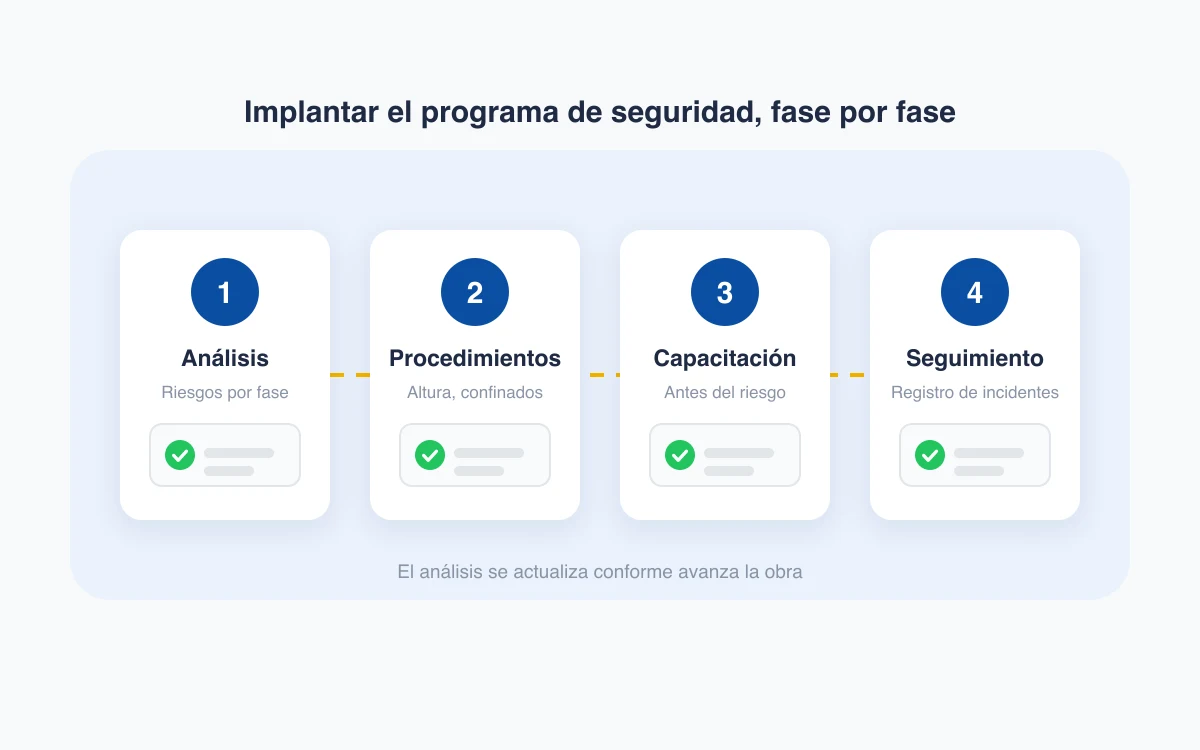
Carry out the risk analysis before the work starts. NOM-031-STPS requires potential risks to be identified according to the size and type of project, before any activity begins. That analysis is the basis for everything that follows: it defines what PPE is needed, what procedures have to be written and which activities supervision should concentrate on.
Set up the Health and Safety Commission. With representatives of the employer and of the workers in equal numbers, as required by NOM-019-STPS-2011. It is not a one-off formality: the commission must meet regularly throughout the project.
Define and supply Personal Protective Equipment by activity. Not all personnel need the same PPE: define what each role and each specific task requires, and check that it is available and in good condition before the activity starts.
Establish procedures for the highest-risk activities. Work at height, confined spaces, excavations and hot work (welding, cutting) each require their own procedure, not the same general rules as the rest of the site.
Train people before exposing them to the risk, not afterwards. Training is not a generic induction formality: it must specifically cover the risks of the activity that person is going to carry out, and be documented so compliance can be evidenced during an inspection.
Hold toolbox talks regularly. A short session at the start of the day or the week, focused on a specific risk relevant to the current stage of the project, holds the team's attention far better than an isolated annual training session. You can see example topics in toolbox talks on site.
Record incidents and near misses, not just accidents. A record that only captures what has already gone wrong misses the chance to correct the unsafe condition before it causes a real accident, and it is exactly the raw material the Health and Safety Commission needs in order to propose preventive measures.
Follow up and update the analysis as the work progresses. Risks change with the phase of the project: those of the foundation stage are not those of the structure or the finishes. A risk analysis that is not updated stops reflecting the reality of the site within weeks of being written.
Common mistakes in site safety management
Treating safety as paperwork rather than daily practice. Having the safety policies printed and filed prevents no accident if nobody applies them in the day-to-day running of the site.
Giving the same generic PPE to everyone, without differentiating by activity. PPE that does not match the real risk of the task gives a false sense of protection, as well as breaching the specific regulation.
Training once, on hiring, and never reinforcing it. The risks on a site change as the project advances; initial training that is not reinforced goes out of date long before the work is finished.
Not documenting the unsafe acts and conditions detected. Without a record, the same unsafe condition can repeat week after week without anyone escalating it, until it finally causes an accident.
Delegating all responsibility for safety to one person with no real authority to stop the work. Appointing a safety officer achieves little if that person has neither the authority nor the backing of management to halt an activity when they spot a serious risk, whatever the pressure to progress that work package.
Leaving the traceability of inspections and training in files scattered among different people. When each site supervisor keeps their own records on loose sheets or in personal folders, reconstructing a project's safety history for an audit or after an incident becomes slow manual work, precisely when that information is needed fastest.
What happens when you do not comply: the real cost of not investing in safety
Failing to comply with construction safety regulation is not only a human risk: it has direct economic and legal consequences. The Federal Labor Law, in article 994, section V, sets fines of 250 to 5,000 times the Unidad de Medida y Actualización (UMA) for employers who fail to observe health and safety rules. With the 2026 value of the UMA, the upper limit of that fine exceeds half a million pesos. On top of that come the costs that appear in no penalty notice: site time lost during an investigation, replacing and training personnel, and reputational damage with clients who require proof of regulatory compliance before awarding a contract.
Seen this way, construction safety stops being an administrative expense and becomes protection for the business itself: every peso invested in risk analysis, adequate PPE and training reduces the probability of an accident whose human, legal and operational cost is always greater than that of having prevented it.
Frequently asked questions
What regulation governs construction safety in México?
Principally NOM-031-STPS-2011, which sets out the occupational safety and health conditions specific to construction work. It is complemented by subject-specific standards such as NOM-017-STPS-2024 for Personal Protective Equipment, NOM-009-STPS-2011 for work at height or NOM-033-STPS-2015 for confined spaces.
Which projects have to comply with NOM-031-STPS?
All construction work carried out on Mexican territory, in any of its activities or phases. The only exceptions are maintenance activities on buildings or installations that require neither a building permit nor notice to the relevant authority.
How often should a site's risk analysis be updated?
There is no single frequency: the advisable approach is to update it whenever the project enters a new phase with different risks, for example moving from foundations to structure, or from structure to services, and whenever an unsafe condition not previously considered is detected.
Who is responsible for safety on site: the employer or the worker?
Both, though with different obligations. The employer must carry out the risk analysis, provide adequate PPE, train personnel and establish the safety procedures. The worker must use the equipment provided correctly and report any unsafe conditions they detect.
What happens if a company does not set up the Health and Safety Commission?
It exposes itself to financial penalties under the Federal Labor Law, and it is left in a weak position in any inspection or employment claim arising from an accident, since the commission is precisely what evidences that the company actively follows up on the safety of its personnel.
Conclusion
Construction safety is not settled with a document signed at the start of the project: it is sustained by an up-to-date risk analysis, an active Health and Safety Commission, the right PPE for each activity, continuous training and systematic recording of what is found in the field. Complying with Mexican regulation is not an obstacle to productivity on site, it is the foundation on which that productivity holds up without interruptions from accidents, penalties or work stoppages. Book a Trowel demo and digitize safety inspections and checks across your sites.