Falls from height are among the most serious accidents in construction, a sector that in 2024 reported 44,474 occupational risks and 140 deaths to the IMSS, according to figures compiled by Obras Expansión. What makes this risk particularly dangerous within construction safety is that it does not require extreme height to be fatal: the Mexican standard regulates it from 1.80 m upwards, and it is at those moderate heights that the risk is most underestimated and protective equipment most often skipped.
In México, work at height is governed by NOM-009-STPS-2011, which sets out the safety conditions for carrying out this type of activity. This guide covers what the standard requires, what equipment is needed, and how to prevent the most common mistake: relying on the worker's experience instead of on the protection system.
What counts as work at height?
NOM-009-STPS-2011 defines work at height as maintenance, installation, demolition, operation, repair or cleaning activities, among others, carried out more than 1.80 m above the reference level. The definition also covers the risk of falling through openings in work surfaces, such as penetrations, pits, shafts and vertical tunnels. In construction, this takes in work on scaffolding, roofs, structures, unprotected slab openings, stair and elevator shafts, and any slab edge without a guardrail in place.
A common mistake is to assume the risk only begins several floors up. In practice, any work above 1.80 m, or next to an opening in the floor, already falls under the standard, and the risk of serious or fatal injury exists from that point on.
Fall protection equipment
Fall arrest system. Made up of a full body harness, a lifeline and a certified anchor point. The three elements have to work together: a harness without an adequate anchor point, or a poorly adjusted lifeline, offers no real protection even if the worker is wearing it.
Collective protection systems. Guardrails, safety nets and covers for slab openings protect everyone in the area, not just the person directly exposed to the risk. The standard calls for fixed barriers, perimeter protection or nets at roof edges, elevated structures and openings, or else for providing the worker with a personal system, and makes the harness mandatory precisely where those protections cannot be installed. Collective protection should be the priority wherever it is feasible, because it does not depend on each person connecting themselves correctly.
Correctly assembled scaffolding. NOM-009 requires, among other things, a guardrail at least 90 cm high with a mid rail when the platform is 1.8 m or more above the ground, a toe board of at least 15 cm, and a visible tag at the access point with the date and the name of whoever inspected the scaffold. A scaffold that is poorly levelled, without toe boards or without a guardrail at the working level is one of the most common unsafe conditions found on site, as described in unsafe acts and unsafe conditions in México.
How to implement a safe work at height program
Analyze conditions before starting. The standard requires a prior analysis of the conditions in the area where work at height will take place. Listing the obvious is not enough (the roof, the external scaffold): also review slab openings, stair and elevator shafts, and slab edges during the structural phase, along with nearby power lines and the movement of people below.
Define the right protection system for each activity, prioritizing collective protection. A guardrail or a net protects the whole team; a harness only protects whoever is wearing it correctly.
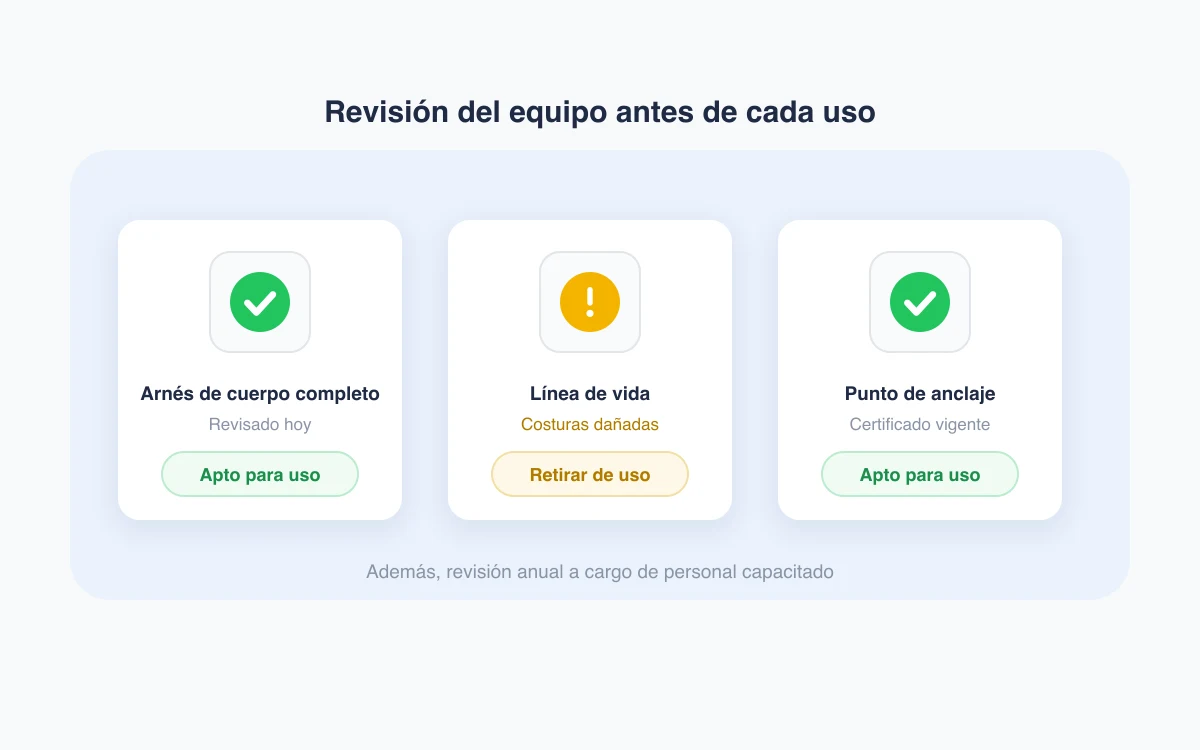
Check the condition of the equipment before every use, not just when you buy it. A harness with damaged stitching or a frayed lifeline must be taken out of service immediately. On top of that, systems and equipment must undergo an annual inspection, or at whatever interval the manufacturer indicates if it is shorter, carried out by trained personnel.
Train people specifically in the use of the fall arrest system. Knowing how to put on a harness is not the same as knowing how to use it correctly: the anchor point, the length of the lifeline and the clearance needed for the system to work in the event of a fall are all part of that training.
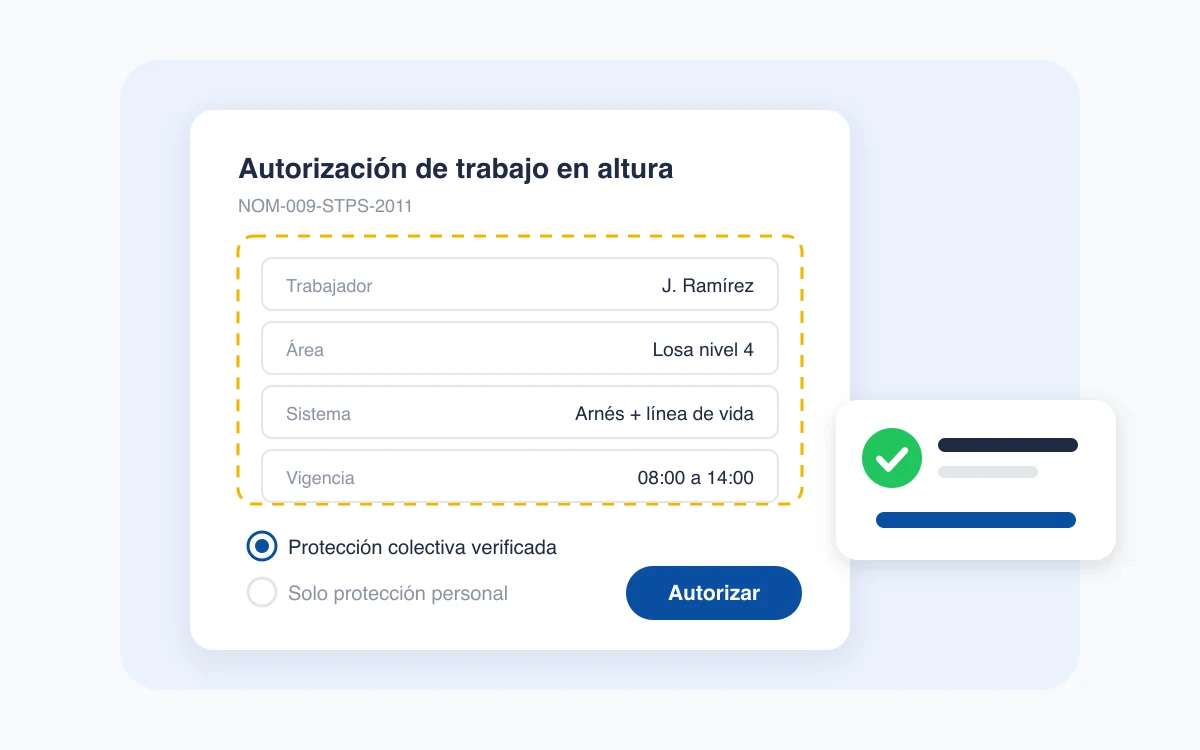
Authorize in writing and check medical fitness. For work on tower scaffolds, suspended scaffolds or elevating work platforms, the employer must issue written authorization giving the worker's name, the work and the area, the safety measures, the date, the start time and the estimated duration, and the signature of whoever authorizes it. Those working at height must also undergo medical examinations at least once a year.
Have the emergency response plan ready. The standard requires a plan covering rescue procedures and the equipment needed. Rescuing a worker left suspended in their harness cannot be improvised: the time spent hanging counts.
Supervise compliance in the field, not just during initial training. Pressure to move fast is one of the most common reasons a worker decides to skip the harness "just for a moment."
A practical example: placing formwork at a slab edge
Here is how the standard applies to a routine building task: two carpenters have to place the perimeter formwork and edge forms on the third-floor slab of an apartment building. The edge is about 6 m above the ground, there are no walls or parapets yet, and the slab below has an opening for the stair shaft.
Prior analysis. The site engineer identifies the risks: falling from the edge, falling through the stair opening, tools or timber falling on anyone passing below, and wind in the afternoon. They also check that there are no power lines near the facade.
Collective protection first. A temporary perimeter guardrail is installed wherever possible and the stair opening is covered with a fixed, signposted cover, not a loose board. Where the carpenters have to work outside the guardrail to place the edge forms, personal protection takes over.
Personal fall arrest system. Each carpenter uses a full body harness with a lifeline and an energy absorber, anchored to a concrete column or to a horizontal lifeline installed for that stretch. The anchor point is never below the working plane, and there is a check that enough clearance remains for the system to stop the fall before the worker strikes the slab below.
Authorization and exclusion zone. If part of the work is done from a tower scaffold, the employer issues written authorization, and above 3.5 m the harness is mandatory on the scaffold as well. At ground level, the area below the edge is cordoned off and signposted so that nobody walks through it.
Inspection and conditions. Before starting, each worker inspects their harness, their connectors and their lifeline. If the wind picks up or heavy rain starts, work at the edge is suspended.
Rescue. The emergency plan sets out who acts, with what equipment and how a suspended worker is brought down, along with the phone numbers of the emergency services.
With this approach the site complies with what NOM-009 requires and leaves evidence of it too: the prior analysis, the authorization, the equipment inspection records and the emergency plan.
Common mistakes in work at height
Using a harness without checking the anchor point. A harness connected to a point that will not take the force of a fall, or to an unsuitable structure, serves no real protective purpose.
Relying on the worker's experience instead of on the protection system. "I have worked like this for years without a problem" does not remove the risk; it only means the accident has not happened yet.
Removing guardrails or protections temporarily and not putting them back immediately. It is common to take a protection out to make one specific task easier and then leave the opening exposed longer than necessary, precisely when someone else may walk through without knowing.
Working at height in adverse weather without suspending the activity. Strong wind, rain or wet surfaces sharply increase the risk of a fall, even when all the protective equipment is correctly installed and in good condition. The standard requires work at height to be avoided or interrupted in heavy rain, electrical storms or sustained strong winds.
Frequently asked questions
At what height do the work at height rules apply in México?
NOM-009-STPS-2011 considers work at height to be work carried out more than 1.80 m above the reference level, and it also covers the risk of falling through openings such as penetrations, pits, shafts and vertical tunnels. You do not need to be several floors up for the standard to apply.
Is a harness mandatory for all work at height?
Not in every case, but it is in many of the situations common on site. The standard requires a personal fall arrest system (full body harness, lifeline, connectors, energy absorber and anchor point) when working at edges or openings where barriers, perimeter protection or nets cannot be installed; on tower scaffolds above 3.5 m; on suspended scaffolds and elevating work platforms; and on ladders above 3.5 m.
How often should fall protection equipment be inspected?
Before every use, following the manufacturer's instructions, plus an annual inspection (or at whatever interval the manufacturer indicates, if it is shorter) carried out by trained personnel, with each inspection recorded. Any harness, lifeline or anchor point showing wear or damage is taken out of service, and a system that has already arrested a fall is not reused unless the manufacturer expressly allows it.
Conclusion
Work at height is the most frequent source of serious accidents in construction, and also one of the most preventable when the protection system is planned, verified and supervised consistently. Book a Trowel demo and digitize equipment checks and work at height training across your sites.